Thursday, November 28, 2013

Apple cider


   Today was Thanksgiving. For school lunch, they served an omelette, corn soup, and cucumber salad, and I shed a single tear.


   Japan has apple orchards, but they don't have apple cider. I don't know what they think they're doing with all those delicious apples.


   Chestnuts seem to be the token Autumn food here. Back in October, everyone was eating "kurikinto," which is chestnut paste shaped into a candy. It has two ingredients: chestnuts and sugar, but it's not very sweet. That fad has passed, but you can still buy baked or candied chestnuts and chestnut lattes.


   I drove past an apple orchard last weekend. I had to drive over an hour, into a more mountainous region of Japan, and then wind my way up a tiny one lane road that cut through a forest that looked like something out of Princess Mononoke. When I got to the top, the apple orchard was already picked clean, so I drove on and found a petting farm with goats, sheep, ponies, rabbits, and lots of little kids. The kids weren't for petting though, they were just visiting. 


   Way back in April or May, there were a few clear days when I caught a glimpse of some snow capped mountains off on in the distance. I don't know why Japan is so hazy, but most of the time, even when it's sunny, everything gets pale and fuzzy on the horizon. This trip, I finally got a better look: a whole range of snow capped mountains.


     Lately I've been missing home a lot, but this drive was a good reminder of why I'm living in Japan. I thought I came here for the language and the culture, but the thing I've enjoyed most is the land.


Sunday, November 3, 2013

This panda is not impressed


   This is a shirt I now own.

   My mysterious chuckle is a little rusty, but I've been practicing.


   Apparently the fashion this fall is flannel shirts and beanie hats. Non-functional suspenders, usually attached to skirts, are also in. As a result, everyone looks like a hipster. I guess it was just a matter of time.


   I tried to go to a cat cafe today. That's a cafe full of cats that you can pet and hang out with while you drink coffee. But when we showed up there was a three hour waiting list. Make a note: you need reservations for the cat cafe.
   I've noticed a lot of stray cats in Japan. If you go to the city, there'll be a bunch hanging out by a river or canal or behind restaurants that they can scrounge food from. Most of them stay away from humans. But the other day I went to a park off in the middle of nowhere and two well-fed, non-spayed cats were chilling in the parking lot, meowing at visitors. I think they had been abandoned. It's also not uncommon to see dogs that are just chained up outside all the time. There's one that I see all the time because it's right on the side of the main road I take to get to the mall. Its fur is dirty and matted, and it's there at all hours of the day, breathing in exhaust fumes from the trucks blowing past. I saw another dog like it in the city today, chained to a tree in front of some run down shop. You could tell by the smell of it that it lived chained there on the sidewalk. It gave us a friendly little jump as we walked past.
   It's pretty depressing! A friend of mine looked into the animal shelter situation, but not only are there very few animal shelters, but the ones around here only keep the animals for two days before putting them down. They don't try to find the animals new homes.


    Here's a link to a poem I like:
 http://www.poemhunter.com/best-poems/marge-piercy/belly-good/

Thursday, October 24, 2013

I totally paused

   When nobody tells you the rules, you just have to figure them out by watching what other people are doing. This can lead to some interesting results.


   I'm talking about traffic rules. As a foreigner in Japan, I'm allowed to wait a year until I take the Japanese driver's test, which is supposedly a bit more rigorous than the American version. I've heard it involves an obstacle course. But so far, I haven't done any studying for the test. I've just been relying on common sense and imitating what other peope do on the road. This is what I've gathered so far.


   No left turns on red. (That's like no right on red in America). 


   Unless it's late at night. Then red lights are more of a guideline. You should slow down, assess the situation, and then blow right through the intersection.


   Even during the day, as long as you're still going pretty fast as the light turns red, it's ok to blast right on through, and the car behind you can follow your lead, too. Also, if you want to make a right turn (that's across traffic) and you're the first person waiting at that red light, it's ok to get a little of a head start before the light actually turns so you can make it across the intersection before oncoming traffic has started moving. 


   If you're on a two lane road, you should definitely change lanes any time someone ahead of you so much as taps on the breaks. 


   In all seriousness though, Japanese people are fairly courteous drivers, at least compared to New Yorkers. They're usually pretty happy to let you pull in front of them, and trucks especially are willing to slow down and let you make that right turn across their lane so that the big line of people waiting behind you doesn't turn into an angry mob. When you let someone cut in front of you, they'll usually blink their lights at you to say thanks. And if you can actually physically see the person, they usually give you a little bow of their head.

   But don't even think about going the speed limit on one of those tiny winding country roads. A big line of cars will pile up behind you, and you'll have to find a place to pull over and let them zoom past before they actually ram into your bumper.

Sunday, October 6, 2013

Dances with cucumbers

   Every day at school lunch we have three dishes. One is usually a bowl of rice. The other is usually soup. The third plate generally holds a slice of fish and a salad, or, less often, a piece of meat and a salad. I say "salad" because that's what they call it here, but it never contains lettuce or even raw vegetables. It's always a pile of boiled vegetables doused in salad dressing, or, less often, mayonnaise.

   The one thing this so-called salad invariably contains is sliced cucumber.


   Cucumbers with  corn and kale. Cucumbers with daikon and sesame seeds. Cucumbers with diced pumpkin. Cucumbers with radishes and carrots. There are endless variations. Apparently everything pairs well with cucumber.


   I went to a nearby castle recently. The other castles I've visited have all been carved out and turned into carpeted, fluorescent-lit museums on the inside. But this one still had its original interior. Unfortunately, all the pictures I took inside came out looking totally lame, so I'll just have to describe it to you.


   The castle had a huge rock foundation, but the rest of it was completely wooden. Huge, dark wooden beams criss crossed the ceilings, and the floor consisted of long, wide slabs of wood. The stairs were ridiculously steep, more like a ladder than an actual staircase. I had to bend my knee way past ninety degrees to get up to the next step.
   The wood was very old but well-cared for. None of the visitors were allowed to wear shoes in the house, so the floors were smooth and shiny. We went on a beautiful, sunny day, and the wood seemed to absorb the sunlight and reflect it back in warm glow. It was pretty hot outside, but it was cool and dark inside.
   One of the scary things, aside from the Cirith Ungol-like stairs, was the fact that you could see light winking up at you between floor boards. The stairs and floors also creaked like crazy, so if any ninjas wanted to sneak in and assassinate a warlord, they'd have to be pretty good.

   Castles and shrines in Japan are traditionally built entirely of wood (and stone). They don't use nails or screws. Instead, they cut the wood so that it fits together perfectly, using other pieces of wood as wedges or locks to hold it all in place. They have a special title for the type of carpenter who knows how to build and repair these all-wood buildings: "Miya-daiku." Castles like the one I visited are repaired, not rebuilt, but some temples and shrines are torn down every fifty or so years and completely rebuilt. One reason for this, presumably, is to keep the craft alive and people with that highly-specialized skill in business.
   It's really cool to examine the ceiling, the railings, and the staircases and see how all the wood was built to fit together.

behind an abandoned coin laundry

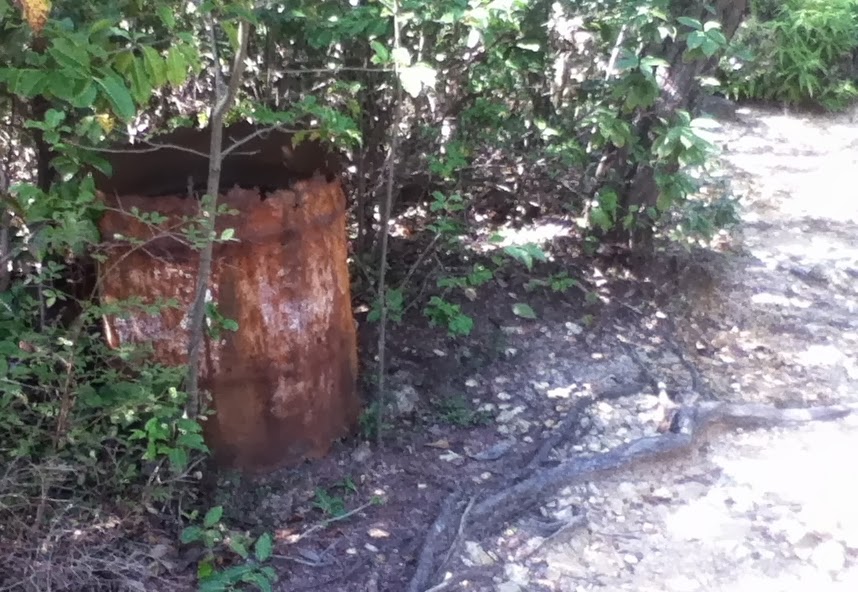
   If you play video games, you'll understand why I am uploading pictures of rusty barrels. I keep happening across these in Japan - something that never ever happened to me in America.

at the top of a hiking trail near a shrine

   In video games, barrels are strategically strewn about warehouses, parking lots, the basements of corporate research laboratories, or the alleys in an urban sprawl - you know, the type of places where you typically encounter barrels in real life.  The red ones always contain something flammable, so when you shoot them (usually takes three shots with a pistol, or a quick click with your automatic rifle) they explode and kill lots of enemies, and maybe you, too, if you are standing too close.

at least this looks like a warehouse where maybe they actually need barrels to store stuff

   But their only purpose in Japan seems to be to convince me that at any moment I might have to drop everything and go thwart an evil, corporate conspiracy or stop aliens from enslaving the human race. 

no red ones. maybe they're just there so i can stack them and jump up to the second story


Wednesday, August 21, 2013

Man-made

   The other day I returned to the dam I visited once before, to see if I would be able to walk across it. It turned out that the dam had a road running on top of it, and not only was I able to walk over the dam, but I was even able to take an elevator down inside it.


   With the rainy season more than a month passed, most of the rivers in my prefecture are running low. Still, it was hard for me to imagine the river so full as to account for the dark stains on the lower portion of the dam. I could see that the banks of the river had less and younger plantlife up to the same level as those stains on the dam, though, so I guess the river must run pretty high sometimes. 


   The view from on top the dam. 


   The view on the other side. 


   I had only expected to walk across the dam, but I discovered a building on top, with an elevator inside, and some visitor-friendly explanations about the history and construction of the dam. I discovered that the dam is about 1300 feet high. I was nervous about taking the elevator, so I waited around until some other people came out of it, to assure myself that it probably wouldn't break and trap me inside.

 
   This was the building with access to the elevator. Aside from the complete lack of people around, the most unsettling part about it was the retro elevator music streaming out of that loudspeaker attached to the door. If I had been holding a portal gun with a potato battery attached to it, I would have felt more equipped to enter.


   I took the elevator down about half way. From the hallway, which had some creepy artwork of children's handprints, I could see through this door to the gate controls.


   This picture makes it look more airy and well-lit than it actually was. It was very damp and musty. That door at the far end led to a stair case leading out of the dam, but at the moment it was off limits. There was also a terrace, but I didn't get a very good picture from it.


   The coolest part about the dam were the stairs and ladders giving access to every part of it. Of course, they were all off limits to me. But it would have been really cool to climb it.


ps I went to a lot of effort not to make the title of this post a pun on "dam." I hope you appreciate it